
In this story
The server asked what you would like. Somehow, you are preparing a defense statement for ordering pasta.
“I was going to get the salad, but I’ve had a long day, and normally I…”
Wonderful. Your dinner now has a legal department. The server still needs a table number.
Restaurant ordering can become exhausting when choosing a meal turns into explaining your entire relationship with food. Here is a simpler way to deal with the menu, the choices and the person who insists on reviewing everybody else’s plate.
A fictional dinner with an unnecessary legal department
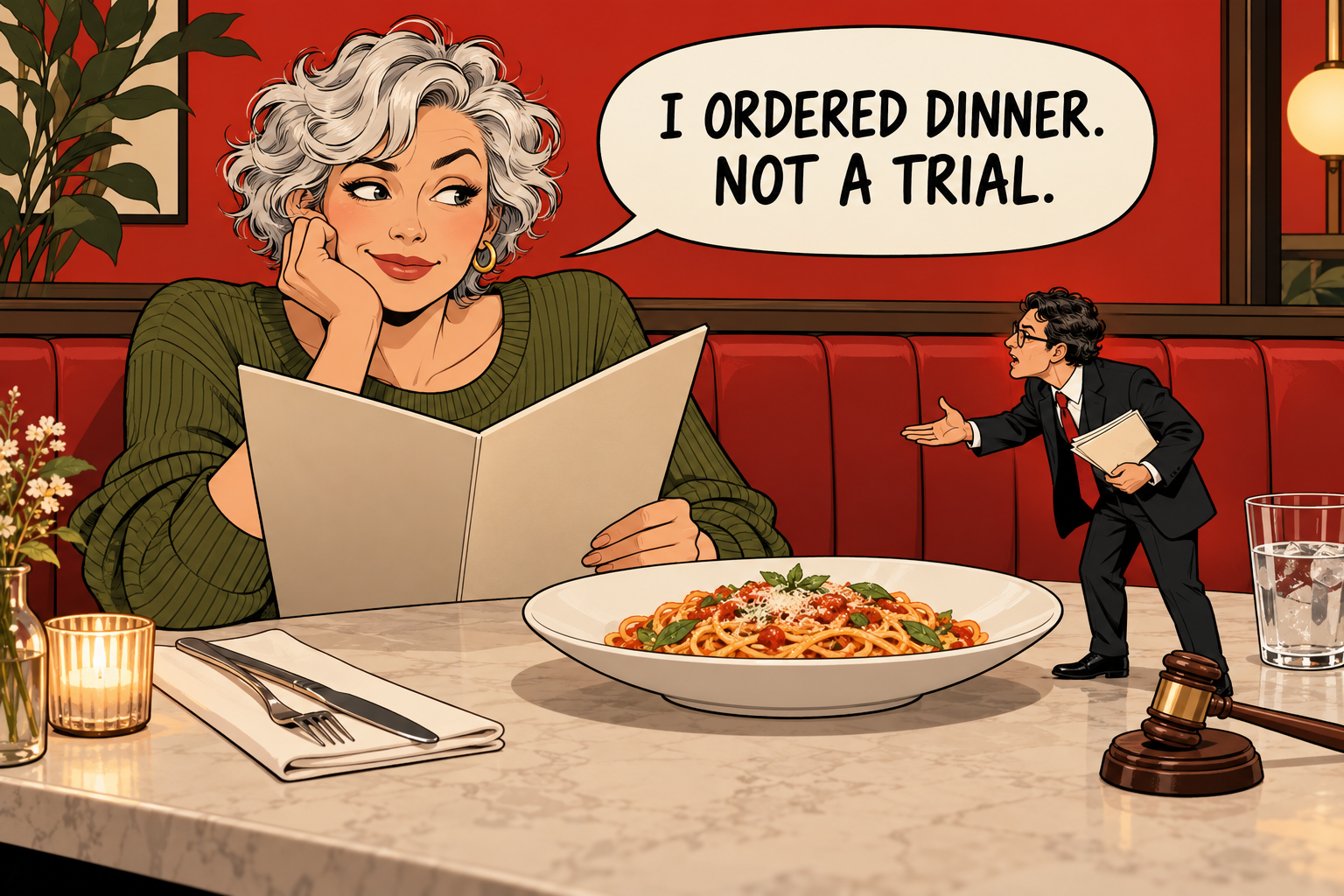
In this entirely fictional scene, Maya sits down at a neighborhood Italian restaurant. Before she can order, a tiny attorney climbs out of her handbag.
“My client would like the pasta,” he announces, “subject to the following mitigating circumstances.”
He unfolds seven pages. Maya’s friend asks whether the garlic bread needs a character witness.
“Just the pasta, please,” Maya says. “And a glass of water.”
The attorney looks devastated. He has billed the bread basket for forty minutes.
You do not need to become wonderfully carefree overnight. You can simply practice making an order without attaching a press release.
Read the menu for information, not approval
Start with a dish you would actually enjoy. Then read what comes with it: the sauce, sides, preparation and any extras. If you have dietary requirements, include those in the decision from the start.
“Fresh,” “wholesome” and “chef’s special” are descriptions, not complete information about a meal. A beautifully printed leaf cannot tell you the portion size. The leaf has no qualifications.
If you use calorie information in your own plan, check whether the restaurant provides it and what the listed serving includes. Avoid inventing a precise number from a photograph. A menu photo is particularly unhelpful at disclosing what happened in the kitchen.
These are ways to understand your options, not a universal formula for the lowest-calorie order. A dish’s name alone cannot tell you how it fits your overall eating plan.
Ask the question that actually changes your order
You do not need to conduct a full kitchen audit. Choose the detail that matters to your decision and ask plainly:
- “What sides come with this?”
- “Is the sauce mixed in, or can it come separately?”
- “Could I choose a different side?”
Availability varies. An answer of “no” is information, not a personal defeat. Pick another option if it suits you better, or order the dish as served.
For allergies or other specific dietary requirements, explain what you need directly to the restaurant. A casual swap is not a substitute for that conversation.
One useful question can settle a choice. Seventeen imaginary arguments with a menu usually cannot.
A short answer for the table’s unpaid food critics
Sometimes the hardest part arrives from across the table: “Are you allowed that?” Apparently dinner includes a surprise licensing inspection.
Try a sentence you can actually imagine saying:
- “This is what I feel like ordering tonight.”
- “I’m happy with my choice, thanks.”
- “I’d rather talk about something other than my food.”
You can change the subject without submitting supporting documents. Ask about their weekend. Discuss the music. Invite a detailed review of the restaurant’s spectacularly uncomfortable chairs.
And if everyone else orders something different, you do not have to revise your order to match. A table is a place to share conversation; it does not require synchronized entrees.
Drinks and dessert can be decisions, too
Take a moment to consider what you want from the whole meal, including drinks and dessert. Check the options and prices. Ask about a serving if the description is unclear. Sharing is an option when everyone involved wants it, not a compulsory ritual.
You can also decline something you do not want without announcing that you are “being good.” Neither ordering nor declining dessert needs to become a personality assessment.
If the evening unfolds differently from your plan, it does not require a dramatic promise to become a new person on Monday. We have already questioned Monday’s suspiciously impressive marketing department in Why Does Everyone Suddenly Want a “New Life” on Monday?
Make your next restaurant order easier
If your recurring problem is “What can I actually order here?”, the Restaurant Guide gives you a more concrete starting point.
It includes a menu decoder, order ideas by restaurant type, familiar-food swaps, and guidance for drinks, dessert and meals that go differently than planned. The current guide covers burger places, Italian, Mexican, Indian, Asian, Greek/Turkish restaurants, cafés and everyday food spots.
It is a standalone digital guide and an optional companion to the RESET SYSTEM, sold separately. Its menu guidance supports planning; it does not guarantee a calorie deficit from any individual restaurant meal.
See the Restaurant Guide’s menu help before your next dinner out.
Back at the fictional restaurant, Maya’s tiny attorney finally closes his briefcase. “Will there be an appeal?” he asks.
“Possibly coffee,” she says.
Cover: AI-generated comic illustration. The characters and story are fictional; the food is illustrative, not a recipe photograph from the guide.